

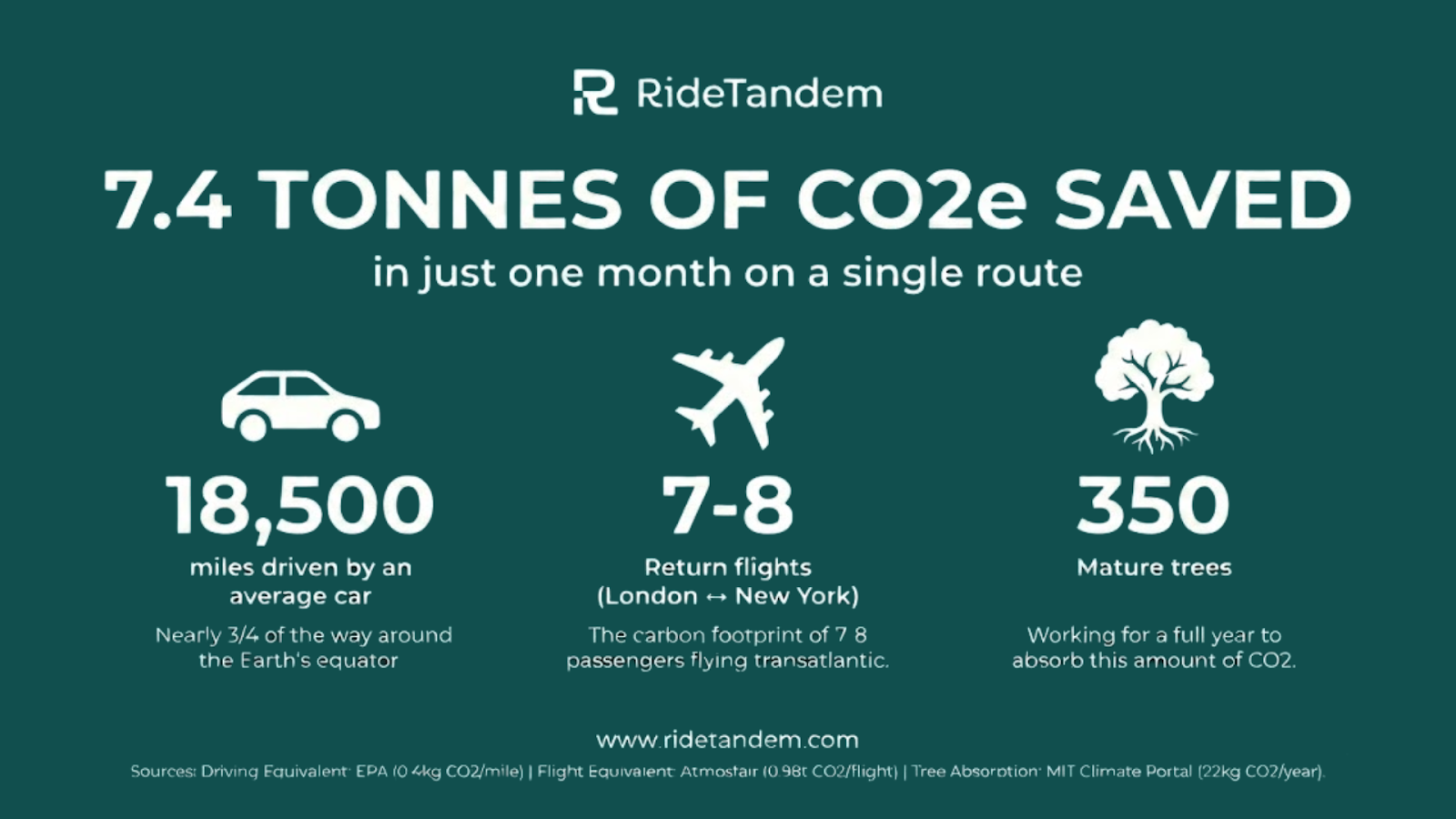
One of the quickest wins for reducing Scope 3 emissions is tackling the daily commute head-on. By consolidating individual car journeys into high-capacity shared transport, organisations can drastically lower their carbon footprint without needing new infrastructure. Replacing the average commuter vehicle (1.16 occupancy)1 with a managed shuttle (25+ occupancy) can reduce carbon output by up to 7.4 metric tonnes per route, per month1.
For many Sustainability Directors, Scope 3 represents the most significant hurdle to Net Zero. It is the largest chunk of your carbon footprint - often accounting for over 70% of total emissions3 - and yet it is the one you have the least control over.
Within that, Category 7 (Employee Commuting) is notoriously difficult to tackle. Unlike Scope 1 (where you can just buy green energy) or Scope 2 (where you can install LEDs), Category 7 relies on the individual choices of hundreds or thousands of human beings.
The traditional answer has been to wait. Wait for the national grid to green up. Wait for employees to buy electric cars. Wait for local councils to fix bus routes.
But with pressure mounting from the board to hit Net Zero targets and new legislation demanding transparent reporting, waiting is no longer a strategy.
.png)
Ending the "Sea of Metal" through displacement
Take a look at your staff car park at 8:50 am.
It’s likely full of vehicles that have spent the last hour crawling through traffic. The average UK commuter car carries just 1.16 people1, meaning a workforce of 100 staff generates about 86 separate exhaust pipes.
This "Sea of Metal" is inefficient, expensive, and environmentally disastrous. It is often the single biggest driver of Category 7 emissions for large employers.
The most effective solution is displacement.
Displacement isn't about convincing 100 people to buy Teslas. It's about moving them out of cars entirely. By deploying a single RideTandem shuttle (average occupancy 25+), you remove approximately 23 private vehicles from the road for every trip the bus makes2.
This isn't theoretical; it’s the exact strategy Stonegate used to significantly reduce their carbon footprint. Since 2019, this approach has helped RideTandem clients avoid over 4,000 metric tonnes of CO22. Clients like Stonegate simply replaced a fleet of individual cars and inefficient taxi runs with a streamlined shared service. The result was a massive drop in carbon output, achieved not by buying new assets, but by using existing ones better.
Why a bad commute costs you talent
Sustainability is often pitched as a "nice to have," but the data shows that a poor commute is actively damaging your business's bottom line.
A study by Robert Half revealed that 23% of workers have left a job due to a bad commute4.
When you rely on public transport that is unreliable or non-existent, you are effectively shrinking your talent pool. If a shift starts at 6 am but the first bus doesn't arrive until 6:30 am, that candidate isn't "unqualified" - they are just "untransported."
Research from the Social Market Foundation (SMF) found that 63% of people say the location of a job puts them off applying5. This creates a "Transport Poverty" trap, where 5 million people in the UK are locked out of opportunities simply because they can't get there6.
By providing a managed shuttle service, you solve two problems at once:
- Environmental: You slash your Scope 3 emissions.
- Commercial: You widen your recruitment catchment area and stop losing staff to competitors who are easier to get to.
Real-world impact: Royal Mail & Stonegate
It is easy to talk about "optimisation" in the abstract, but what does it look like on the ground? Since 2019, RideTandem has provided a 24/7 managed service that has enabled over £100 million in wages for passengers8.
Royal Mail: Peak agility
During the Christmas peak, Royal Mail needs to scale its workforce rapidly. Relying on public transport for temporary staff working odd hours (e.g., 4 am starts) is impossible.
RideTandem deployed a flexible shuttle service that received over 25,000 passenger bookings in 5 weeks7. If a worker didn't show up for the bus, the agency knew about it before the shift started, allowing them to backfill the role instantly.
This reliability meant parcels got delivered on time, and workers (many of whom didn't own cars) could access jobs they would otherwise have been excluded from.
GXO: Ramp up recruitment
RideTandem supported GXO and its agency suppliers to recruit an additional 250 people during a peak period with a rapid ramp-up phase. Due to poor public transport links, the site was impossible to reach without a car and two routes were needed to match GXO shift times.
RideTandem reduced costs for GXO by over 56% compared to providing buses directly, helped to avoid over 36 MT of CO2 per month and covered the full cost of the service with passenger fares during the busiest period - making the fully-managed service cost neutral.
Optimisation before electrification
Many businesses delay their transport strategy because they assume they need to wait for a budget to cover a fully electric fleet. They think "Sustainability = Electric Buses."
While electrification is the long-term goal, route optimisation is the immediate win.
A Euro 6 diesel coach running at full capacity is significantly more carbon-efficient per passenger kilometre than 20 private petrol cars running at partial capacity. You don't need to wait for infrastructure upgrades to make an impact.
We use proprietary technology to build routes based on precise employee location data, not fixed bus stops.
- Traditional Bus: Drives a fixed loop regardless of who is on board.
- RideTandem Smart Route: Only goes where the passengers are.
This dynamic approach eliminates "dead mileage" - miles driven with empty seats - and ensures every mile counts. It’s this focus on operational efficiency that underpins our B Corp Certification. We don't just run buses; we run data-led transport networks that adapt as your workforce shifts.
Closing the data gap for ESG reporting
If you are a Sustainability Director, you know that "Category 7" reporting is often the most frustrating part of the job.
Usually, it involves sending out an annual staff survey. You ask: "How do you get to work?" and "How far is it?"
- 30% of staff reply.
- Half of them guess the mileage.
- You extrapolate that data to cover the whole company.
The result is a vague estimate that wouldn't stand up to a rigorous audit.
Managed transport closes this data gap completely. Because every passenger books their seat via the RideTandem app, you get access to precise datasets automatically. Our Client Dashboard shows you:
- Exact mileage travelled per employee.
- Vehicle type and emissions standards (Euro 6, EV, etc.).
- Real occupancy vs. theoretical car journeys.
This shifts you from "best guess" estimates to audit-ready data. When it comes time to publish your annual ESG report or apply for B Corp recertification, you have the numbers right there. You can prove, with line-by-line data, exactly how much carbon you have saved.
Ready to measure your impact?
The pressure to reduce Scope 3 emissions is not going away. But neither is the need to recruit and retain staff.
Managed transport is one of the few initiatives that solves both. You don't need to rebuild your infrastructure, dig up your car park for chargers, or wait for 2030. Significant reductions in Category 7 emissions are available today through efficient commuter displacement.
Stop estimating your impact. Start measuring it.
Click here to book a demo and calculate your potential carbon savings.
Sources
- RideTandem Internal Data
- RideTandem: Sustainable Transport Solutions
- World Economic Forum: Scope 3 emissions are key to decarbonisation
- Robert Half: Nearly One-Quarter Of Workers Have Left A Job Due To A Bad Commute
- Social Market Foundation: Recovering the lost workforce
- Social Market Foundation: Transport poverty gap
- RideTandem Blog: How RideTandem supported Royal Mail during peak season
- RideTandem Blog: RideTandem enables £100 million in wages for passengers
